
By Doyle Irvin, American Forests

The artists who really intrigue me are those who can make me rethink everyday life. They take a normally overlooked aspect and create something beautiful out of it, forcing me to pause and reconsider everything I wouldn’t usually notice. So that’s what I am bringing to you today: artists who question our place in the world.
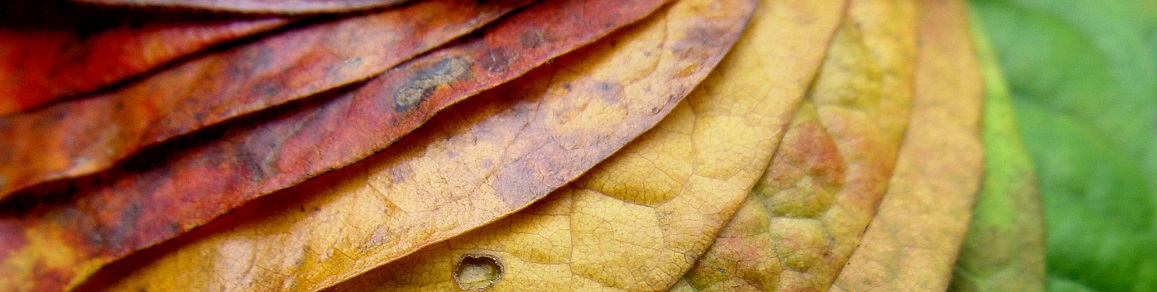
Perhaps the easiest example is Andy Goldsworthy, OBE. The British sculptor and environmentalist uses all-natural found materials and sculpts them into geometric shapes, employing stunning use of color and linear perspective.
It’s hard to always stop and smell the roses. What’s so special about fallen leaves? There are millions of them. Yet Goldsworthy’s work brings out the inherent beauty in the world around us, and make us notice.
If you want to see more of his work, you can find it here and this archive of his work, created by his partner, Dr. Tina Fiske.


Why is his work so powerful? Scientist Richard Taylor began looking into the effects of art on the human psyche, and found pretty interesting links between nature and art. “Although aesthetics is often regarded as an ill-defined vague quality, research groups like mine are using sophisticated techniques to quantify it – and its impact on the observer,” he writes. “We’re finding that aesthetic images can induce staggering changes to the body, including radical reductions in the observer’s stress levels.”
He uses a tree as an example – trunk, branches, twigs; all are fractal delineations, following a pattern that gets repeated over and over. When it comes to humans, they discovered what they call “fractal fluency,” which is two-fold: the first aspect is that we evolved in nature, and were thus exposed to (and comfortable in) surroundings that are inundated with fractals; the second aspect is that artists intuit this comfort and recreate it in their work.
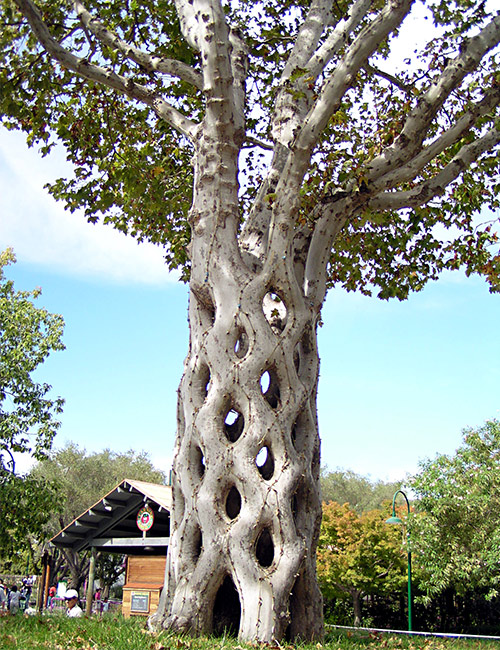
Another example of an artist using nature (and fractals) to create something special is Axel Erlandson. He used living trees and shaped them into patterns that make it easy to raise the question – what is our life? How do we shape it? How are we ourselves shaped?
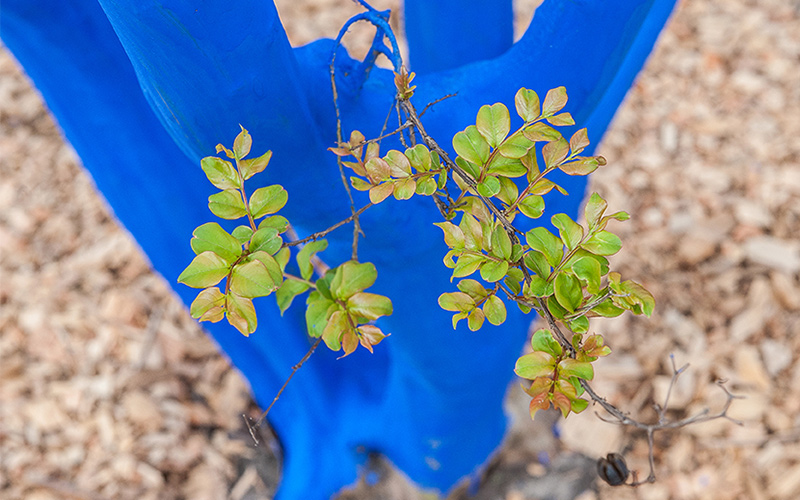
You can find more tree-shapers here.Some tree-artists are a little more upfront with their messages, however. Denver-based environmentalist and artist Konstantin Dimopoulos painted more than 100 trees in downtown Denver bright blue, using biologically safe paints. He states that the project is meant to draw attention to climate change. “I want people to notice the trees,” Dimopoulos says, “to see them as more than just wallpaper in their lives. Change can be threatening. Changing a local environment through color is both disconcerting and even uncomfortable.”
You can learn more about the project in 303 Magazine.

Credit: Konstantin Dimopoulos and photographer Dave Brown
You don’t have to be alone to appreciate nature! The Red Earth Project is a collective of artists that we think are particularly cool. They come together to stage site-specific installations and performance pieces that respond to landscapes all across the world. They bring together not just artists but also archaeologists, farmers, historians, local communities and more, in order to delve into the heritage of the Earth and those who walk upon it. Pictured here is their project, Outcrop, which is “A series of 30ft high sculptures on the South Downs Way, constructed from green wood and stitched wheat … the forms were inspired by visible stages of vegetation growth; the photosynthetic urge upward countered by the increasing weight of the fruit it bears, pulling the structure back towards the earth.”


How cool is that? These are the projects that bring me away from the screen, away from LCD’s flickering thousands of times a second, away from subway armpits and muffler grease, away from the treadmill and the elliptical and their faux-motion. May they ever continue.