For 150 years, American Forests has incubated science-backed innovations to tackle the complex challenges facing communities and the landscapes they call home. From the idea that spawned the U.S. Forest Service to the data behind the Tree Equity Score tool, our work is rooted in real needs identified through collaboration with partners.
We place people at the center — because tools are only effective if they are available, accessible and actionable.
“We believe access is power,” says Julia Twichell, American Forests’ senior director of data, design and UX. “That’s why our tools are free, increasingly multilingual and designed for usability so anyone can use them to restore forests and reforest communities.”
Photo Credit: Mark Janzen / American Forests
Science-backed decision support for those needing it most
Climate change, economic conditions and an evolving network of landowner support programs make for increasingly complex and consequential decision making by those on the front lines of climate impacts. Climate and forestry data are often highly technical, difficult to interpret, locked behind paywalls or a combination of all three. These barriers limit access to the information forest stewards weigh when making decisions.
Gaps in information access are most pronounced among underserved family forest owners and Tribal Nations reeling from profound wildfire impacts. While emerging markets for ecosystem services like carbon, water and biodiversity hold promise to empower stewards to take restorative actions, landowner-centric information about these markets remains limited and difficult to interpret. Related barriers include access to foresters and upfront costs for land preparation and seedlings.
To help close these gaps, American Forests has developed new tools that connect private landowners and Tribal Nations with foresters, technical assistance and financial resources. In collaboration with market and forest-modeling experts, we have developed carbon and water benefit calculators that help landowners and foresters make informed decisions on market participation, potentially unlocking access to funding aligned with their ecological, financial and cultural values.
Beyond developing tools, American Forests works directly with private landowners and Tribal Nations to support reforestation planning and market feasibility assessment — without pressure to enroll in market-based programs or access public funding. Our goal is to provide best-in-class, science-based and culturally relevant support for reforestation and restoration.
“As the saying goes, knowledge is power, and we’re aiming to empower landowners with the ability to make informed decisions for themselves,” says Frank Curtin, American Forests’ director of private lands reforestation.
Curtin and his colleagues are helping landowners find the right resources in a fragmented information environment. Today, reforestation information is scattered across agencies and websites, making it difficult for landowners to know where to begin. To address this, American Forests will launch a new web platform in early 2026 to help landowners navigate reforestation programs, funding opportunities and events, and connect directly with local foresters, agencies and American Forests’ place-based forestry staff. The platform will allow landowners to identify and leverage resources that support their unique restoration goals.
Reforesting private lands requires all hands-on deck — and access to the right resources at the right time. A win for one ecosystem is a win for all.
Investment in data evolution to increase access for all
Creating a new tool is just one step. Ensuring it remains relevant requires continual investment. Data evolves, as does its applications.
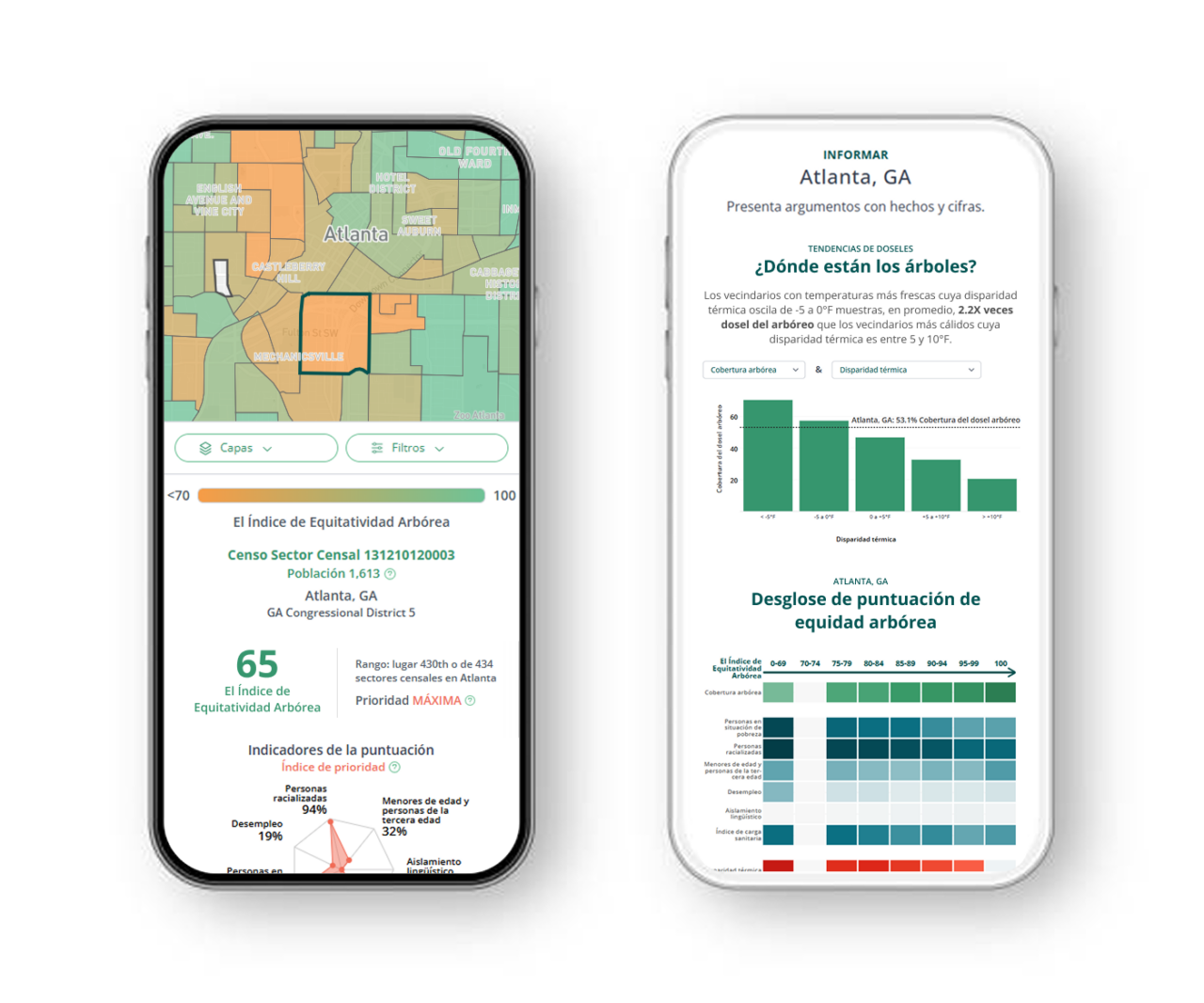
At its inception, American Forests’ Tree Equity Score was barely more than a radical idea. A map of nationwide tree cover seemed a tall order — yet Tree Equity Score launched in 2021, not just with nationwide tree-cover data, but also with deeper views of each neighborhood that included socioeconomic status, public health, race, age, heat severity and more. It became more than just a map of trees, reflecting everyday lived experiences in cities across the United States.
Now with 16 applications and counting, Tree Equity Score is a groundbreaking international platform paving the way for more than 1,000 cities to champion the Tree Equity movement. Five years since its launch, Tree Equity Score continues to evolve and reach new communities. Last November, the platform unveiled a Spanish-language version to expand access.
Earlier in June, American Forests and the Washington State Department of Natural Resources announced the first statewide Tree Equity Score Analyzer, designed to help policymakers and leaders leverage high-resolution data to equitably plan for urban forestry one city lot at a time. And in January 2026, the City of Austin announced the official adoption of the Austin Tree Equity Score Analyzer as their tree prioritization tool. American Forests has always sought to better meet local needs by improving the Tree Equity Score platform, incorporating ideas ranging from localized to aspirational.
Data is only as powerful as the uses we put it to. Whether with Tribal stewards or community advocates, the most powerful tools place the right data in the right hands — so the benefits of trees reach everyone.