
If it wasn’t enough of a threat to America’s sweet tooth that climate change may affect maple syrup yields in the next 50 years, the sugar maple is facing another threat as well — an invasive pest. We’re wrapping up Invasive Species Awareness Week by shining the spotlight on a tiny pest with big consequences: the Asian longhorned beetle or ALB.
ALB is a black beetle between one and one-and-a-half inches long, with white spots and — as its name implies — two antennae that are even longer than its body. In addition to recognizing the beetles themselves, you can also spot them by signs of occupation on the tree. In early autumn, females dig out oval depressions in which to lay their eggs. When the larvae hatch, they burrow into the wood to feed and grow through the winter. In spring, they emerge as adult beetles, leaving tell-tale, dime-sized holes behind them.

ALB most likely arrived by way of wooden packing crates from their native range of China and parts of Korea and Japan. Their presence has already cost the U.S. tens of thousands of trees and hundreds of millions of state and federal dollars, and that’s just in the few states where they’ve established themselves so far: New York, New Jersey, Massachusetts and, previously, Illinois. If they get a chance to spread throughout the country, they have “the potential to cause more damage than Dutch elm disease, chestnut blight and gypsy moths combined” and kill 30 percent of the country’s hardwoods, according to the U.S. Department of Agriculture.
The maple industry, in particular, is worried. This $41 million industry has already been affected in Massachusetts, where more than 60 square miles are under quarantine, and nearby Vermont and New Hampshire are keeping a close eye for signs of the bug. Sugar and other maples also give us some of the most vibrant fall colors. One million tourists flock to New England to leaf peep every fall, bringing a billion dollars in tourism revenue with them, all of which could be at the mercy of ALB if it continues to spread.
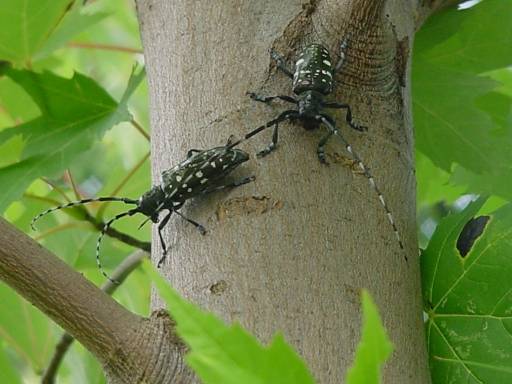
What’s more, while maples appear to be a favorite of the beetle, they are not the only trees in danger. Unlike some pickier beetles, ALB enjoys a wide variety of deciduous hardwood trees, including ash, birch, elm, poplar and willow. This means that the maple-dependent industries will not be the only ones in danger. ALB could have far-reaching consequences for the lumber and nursery industries, too.
But there is hope. ALB has already been eradicated in Illinois and in certain counties of New Jersey and New York.
What can you do? Using local firewood is one of the most important ways to prevent the spread of ALB and other invasive pests. Check out http://www.dontmovefirewood.org/ to learn more.